Where Is Fallingwater and Why It Changed Modern Architecture
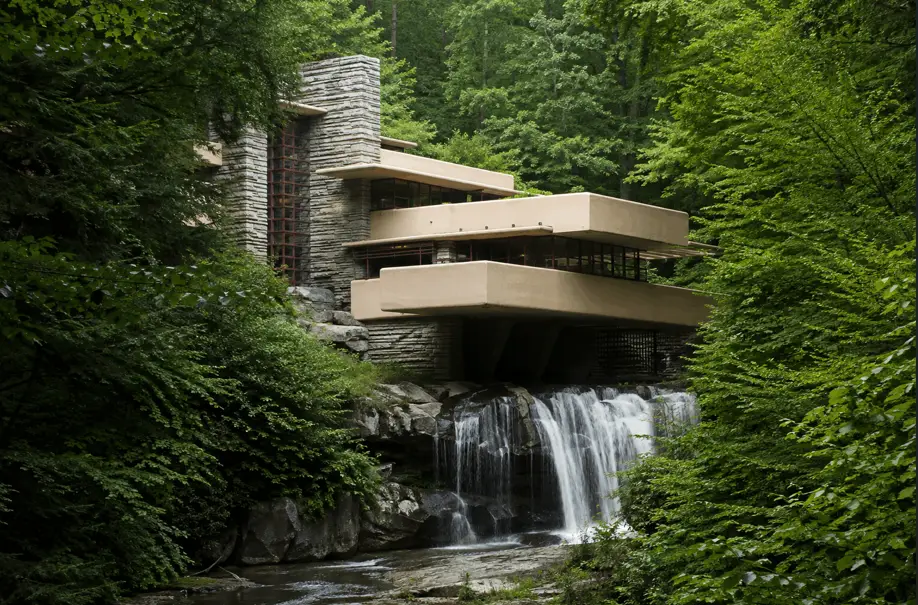
Table of Contents
- Where Is Fallingwater and Why It Changed Modern Architecture
- Where Is Fallingwater?
- What the Fallingwater House Looks Like
- Why Fallingwater Changed Modern Architecture
- What Fallingwater Is Used for Today
- A Building That Still Matters
- FAQs
- Is Fallingwater considered modern architecture?
- Why was Fallingwater built over a waterfall?
- Can you visit Fallingwater today?
- Are people allowed to live in Fallingwater?
Fallingwater is a house built directly over a working waterfall in the Pennsylvania wilderness, and it is one of the most photographed homes ever constructed. When Time magazine polled architects in 1991 to name the greatest American building of the twentieth century, Fallingwater came first.
Completed in 1939, the house was built in less than two years. Wright reportedly sketched the entire design in about two hours one morning, after leaving his client waiting for months. That detail alone tells you something about what kind of building it is.
Where Is Fallingwater?
Fallingwater sits in Mill Run, Pennsylvania, roughly 70 miles southeast of Pittsburgh in the Laurel Highlands. The site is part of the Bear Run Nature Reserve, a 5,000-acre woodland property in the Allegheny Mountains managed by the Western Pennsylvania Conservancy.
The house was built for Pittsburgh department store owner Edgar Kaufmann Sr. and his family, who used Bear Run as a weekend and summer retreat. Rather than orienting the house to view the waterfall from a distance, Frank Lloyd Wright built it directly above the falls, anchoring the structure to the boulder ledge and letting the water run beneath and through the building itself.
The address is 1491 Mill Run Road, Mill Run, PA 15464. Getting there involves a winding drive through forested hills. The house is not visible from the road, which is deliberate. Visitors approach through the trees and encounter the building at close range, which heightens the impact considerably.
It has been open to the public as a museum since 1964, the year after Edgar Kaufmann Jr. donated the property to the Conservancy.
What the Fallingwater House Looks Like
-
The exterior
The exterior is a stacked series of reinforced concrete trays cantilevering out over the waterfall in two directions at once. The longest cantilever extends 18 feet beyond its support without a column underneath.
Wright used the natural sandstone ledge of the site as both foundation and interior flooring, so the rock literally comes up through the living room floor. The walls are a warm ochre-colored concrete. The horizontal window bands are painted Cherokee red. The whole composition reads like a natural formation that happens to have windows.
-
The interior
Inside, the ceilings are deliberately low to heighten the drama of the views outward. The main living area opens onto a suspended terrace that hangs over the waterfall. A staircase drops directly from the living room down to the stream below, which is exactly as theatrical as it sounds. The sound of falling water is audible throughout the house, which was entirely intentional.
-
Structural Correction
What photographs tend not to show is that the building struggled structurally almost from the start. The cantilevers began deflecting and cracking shortly after construction. For decades, the sagging worsened, and by the 1990s, the situation was serious enough to require a major intervention.
Post-tensioning cables were threaded through the concrete and tightened to pull the structure back into alignment. The repairs took years and cost millions. The structure is now stabilized, but the building's history includes a long chapter of engineering challenges that the famous images do not capture.
-
The Limitations
As a place to actually live, Fallingwater had real limitations. The dampness from the waterfall created persistent moisture problems. The low ceilings and tight rooms that look so dramatic in photographs made the interior feel cramped for daily use.
The Kaufmann family used it as a weekend retreat rather than a full-time residence, which was probably the right call. It was designed as an experience first and a practical home second.
Why Fallingwater Changed Modern Architecture
Before Fallingwater, modernism in America was largely associated with flat industrial aesthetics imported from Europe; white boxes, steel and glass, minimal ornament, and a deliberate separation from nature. Frank Lloyd Wright's Fallingwater house proved that something different was possible.
Here was a building that used modern structural technology, reinforced concrete cantilevers, open plans, flat roofs, and integrated them completely with a natural site. It felt warm, dramatic, and rooted in its landscape at the same time as being unmistakably modern.
The cantilever became iconic. The idea that a floor plate could extend dramatically beyond its support, unsupported and horizontal against a vertical natural backdrop, entered the visual vocabulary of modern residential architecture and has never really left. Architects and clients saw Fallingwater and understood that the structural possibilities of concrete could be used expressively, not just efficiently.
The relationship between building and nature that Fallingwater demonstrated shifted how American architects thought about the site. Instead of clearing and leveling land to create a platform for a building, Wright showed that a building could engage with topography, water, and vegetation as active design elements. That idea runs through decades of residential architecture that followed.
When photographs of the house were published in 1938, Fallingwater became famous almost overnight. It was reproduced in newspapers and magazines across the country and established Wright, who had been largely out of the spotlight for years, as the defining figure of American modernism.
The house is probably responsible, more than any single building, for the image most Americans carry of what great modern architecture looks like.
What Fallingwater Is Used for Today
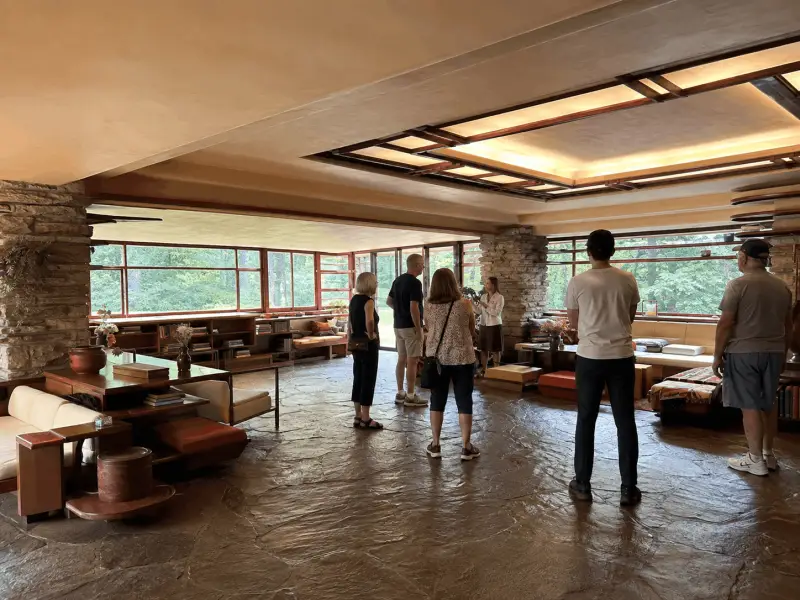
Fallingwater is operated by the Western Pennsylvania Conservancy and is open for guided tours most of the year. Standard tours cover the main house and terraces. In-depth tours include areas not on the standard route and are limited to small groups. The house receives around 170,000 visitors a year, and total visitation since it opened to the public has surpassed six million.
In 2019, Fallingwater was designated a UNESCO World Heritage Site as part of a group of eight Frank Lloyd Wright buildings recognized for their outstanding contribution to modern architecture. It was the first time a group of American buildings from the twentieth century received that designation. The visitor center, gift shop, and cafe on the property were designed to remain deliberately unobtrusive so that the house itself dominates the experience of the site.
A Building That Still Matters
More than eighty years after it was completed, Fallingwater remains one of the most recognized and studied homes in the world. Architecture students visit it as a pilgrimage. Practicing architects reference it when talking about how buildings should relate to the landscape. Photographers have shot it from every possible angle in every season, and the image of those concrete trays floating above the waterfall has not lost any of its power.
It is both a museum and a symbol, a reminder that American modernism at its best was not cold or mechanical but grounded, expressive, and deeply connected to the natural world. As long as that idea matters to architecture, Fallingwater will keep mattering too.
If you're curious about properties in the Laurel Highlands area or anywhere in Pennsylvania, publicly available ownership and zoning records can be searched by address at PropertyChecker.com.
FAQs
Is Fallingwater considered modern architecture?
Yes, though Wright's version of modernism was distinct from the European tradition. He rejected what he called the international style in favor of organic architecture that responded to site and landscape. Fallingwater uses the materials and structural techniques of modernism but applies them in a way that feels rooted in its natural setting rather than imposed on it.
Why was Fallingwater built over a waterfall?
Edgar Kaufmann Sr. had expected Wright to position the house to look at the waterfall from across the stream. Wright had a different idea. Building directly over it put the occupants inside the experience of the falls rather than viewing it from a distance. The sound, the moisture, and the movement of the water became part of living in the house. It was an unusual choice, and it was the right one.
Can you visit Fallingwater today?
Yes. Fallingwater is open to the public for guided tours most of the year, with limited winter hours. Tours range from standard walkthroughs to in-depth experiences that access areas not included on the main route. Advance booking is strongly recommended, especially during peak season. Full details and tickets are available at fallingwater.org.
Are people allowed to live in Fallingwater?
No. Since Edgar Kaufmann Jr. donated the property to the Western Pennsylvania Conservancy in 1963, it has been preserved and operated as a museum. No one has lived in the house since the Kaufmann family used it as a retreat. It is maintained as closely as possible to its original condition.

Elena Novak leads real estate research and analysis at PropertyChecker.com, where she digs into housing trends, tracks property data, and unpacks investment strategies across the U.S. With a background in flipping homes and a degree in Business and Real Estate Development, she brings a practical, hands-on approach to market analysis. Elena is especially skilled at uncovering hidden property value and guiding both homeowners and investors through shifting market conditions. She's also passionate about sustainable design and smart home innovation. When she's not analyzing the market, she's probably knee-deep in a DIY project, scouting vintage décor, or building something new in her workshop.
Search Property & Deed Records
Table of Contents
- Where Is Fallingwater and Why It Changed Modern Architecture
- Where Is Fallingwater?
- What the Fallingwater House Looks Like
- Why Fallingwater Changed Modern Architecture
- What Fallingwater Is Used for Today
- A Building That Still Matters
- FAQs
- Is Fallingwater considered modern architecture?
- Why was Fallingwater built over a waterfall?
- Can you visit Fallingwater today?
- Are people allowed to live in Fallingwater?