What to Check Before Buying a Home That Floats on Water
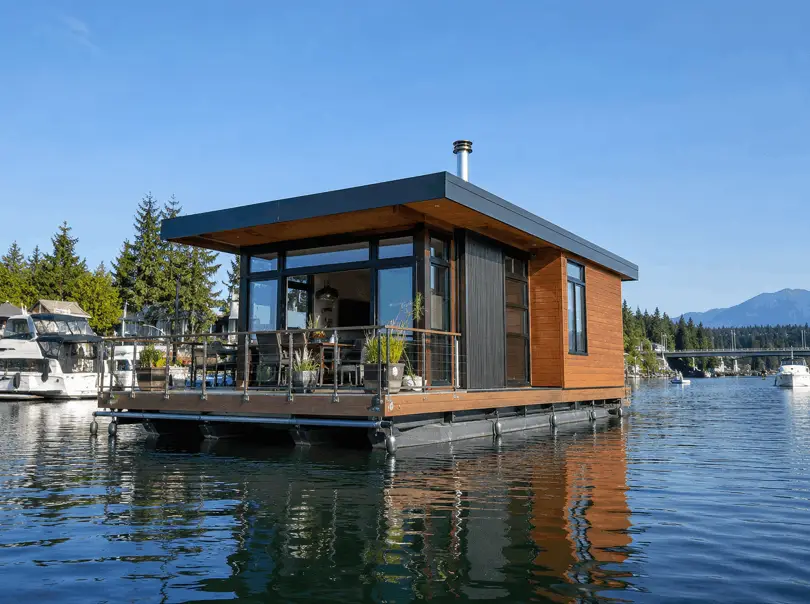
Table of Contents
- What to Check Before Buying a Home That Floats on Water
- Floating Homes vs Houseboats
- Floating House Designs and Life on the Water
- Exterior Styles
- Interior Feel
- Outdoor Living Appeal
- Where to Find Floating Houses for Sale
- What Should You Know Before Buying a Floating House?
- Legal Classification
- Mooring Rights
- HOA or Marina Rules
- Utilities Requirements
- Maintenance Expectations
- FAQs
- What is a house floating on water called?
- What are the disadvantages of float houses?
- Where does the sewage go on a floating home?
- What is the lifespan of a floating house?
Floating homes are built to sit directly on water rather than on land. Most are permanently anchored in place and connected to utilities like electricity, water, and sewage, making them suitable for full-time living.
What makes them different isn’t just the location, but the experience. Living on the water means constant views, changing light, and a closer connection to the surroundings, something traditional homes can’t easily replicate.
Floating Homes vs Houseboats
Although the terms have similar meanings, floating homes and houseboats describe two completely different things. A floating home is a non-mobile building that is permanently anchored into the surface of the water by being built on either a barge, pontoon, or concrete hull.
Floating homes are connected to city services, such as utility electricity, water, and sewage systems, thus they are considered to be the same type of property (i.e., a house). Floating homes do not have powerful motors, nor are they able to navigate through the water.
In contrast, houseboats are primarily navigable vessels that function as a home. Houseboats can be propelled through the water by either having their own propulsion systems or by being towed by another vessel.
Houseboats are registered with the state (in most places) as a watercraft, and as such, they are considered to be personal property instead of real property. Because of these distinctions, the manner in which houseboats and floating homes are financed, insured, and treated legally differs significantly.
For potential purchasers, it is crucial to understand the differences between a floating home and a houseboat, because floating homes are generally easier to get mortgages, insurance, and resale through typical real estate channels compared to houseboats.
Furthermore, a floating home generally provides more total livable area and is much more stable than houseboats.
Floating House Designs and Life on the Water
The floating houses have a wider visual range than most people think.
Exterior Styles
At one end, there are modern/Scandinavian-style floating homes with flat rooflines and big windows; these could easily be photographed for a magazine. At the other end of the scale are converted barges and industrial-hull homes. These have a rustic charm and unusual design features, such as porthole windows, round rooflines, and exposed steel, giving them an industrial look.
Interior Feel
The interior design is generally focused on giving the resident the best possible view of the water by using wide windows and glass doors. The floor plans are oriented to have the main living space facing out towards the water. Open-plan kitchens with open living rooms are commonplace because they give the illusion of more space, but also because it is structurally more difficult to build internal walls.
The natural light reflecting off the water creates a different feel than normal. Designers who understand floating homes use the natural appearance of light reflected from the water to illuminate the interior.
Outdoor Living Appeal
An outdoor lifestyle is one of its primary attractions. Many of the floating homes have decks, roof terraces, and wraparound walkways; these are well used because the owners chose to live on the water.
Sitting on a deck at water level and watching the light shift across the surface is an experience no garden or balcony can replicate. This is one of the key reasons prospective purchasers fall in love with this type of property.
There are viable interior challenges to overcome; the spaces are usually smaller than those in a home on land, and the number of storage areas will require some out-of-the-box thinking.
The floating home will move gently due to the hull's movement from wind or passing wakes from other boats. However, most residents of floating homes say that after a couple of days, they do not notice it or find it reassuring.
Where to Find Floating Houses for Sale
Most floating homes are sold in places where there are already moorings, utility connections, and markets for them. This is typically found in certain cities and waterway communities. The Pacific Northwest is one of the largest markets for floating homes in the US (especially Portland and Seattle) because both cities have existing floating home communities as well as communities with available moorings, utilities, and active buyers. Sausalito, in the San Francisco Bay Area, also has a significant number of established floating-home communities.
In Europe, Amsterdam is the most notable city for floating houses. The city has approximately 2,500 floating homes. London's river systems (the Thames and Regent's Canal) also have an active community of floating home residents, but their numbers are smaller than in Amsterdam. Other notable cities include Copenhagen, Stockholm, and various points along the French canal system.
In quieter rural settings, floating homes occasionally appear on lakes and rivers where mooring rights exist, and local rules permit residential use. Due to lower population density, floating homes in non-urban areas typically offer more space and privacy than those at an urban marina. However, this type of living may be further away from services and amenities.
Searching for floating homes typically requires more effort than searching for traditional homes via real estate sites. While listing services such as Zillow and Realtor.com do have floating home listings, there are other sources of information. Specialty waterfront brokers and agents at marinas often have access to properties that are not publicly listed on the internet.
Additionally, there are many niche websites dedicated to the sale of waterfront property and alternative housing, as well as local groups associated with established floating home communities that can be helpful to potential buyers.
What Should You Know Before Buying a Floating House?

Buying a floating home involves a few layers of due diligence that do not come up with a typical property purchase, and it pays to understand each one before you commit.
Legal Classification
The first thing to establish is how the property is legally classified. A floating house treated as real estate is financed and transacted differently from one classified as personal property or a vessel. Real property classification makes conventional mortgages available; personal property classification usually means a chattel loan, which comes with different terms and rates.
Mooring Rights
Mooring rights are central to any floating home purchase. You need to know whether the right to occupy the mooring transfers with the home, what the terms of that agreement look like, and how secure the arrangement is long-term. Some moorings are owned outright; others are leased from a marina, harbor authority, or private landowner. Losing a mooring without an alternative is a serious problem, so understanding the tenure is not optional.
HOA or Marina Rules
Marina and homeowner association rules vary considerably. Some floating home communities are tightly governed, with rules covering everything from exterior appearance to noise and guest policies. Others operate more loosely. Reading the rules before buying is important, particularly if you have specific plans for how you want to use and present the property.
Utilities Requirements
Utilities deserve careful attention. Shore power connections, water supply, and sewage hookups are standard in established floating home communities, but the condition and capacity of those connections vary. Inspect them as thoroughly as you would the structure of the home itself.
Maintenance Expectations
Maintenance on a floating home is ongoing and differs from land-based property. The hull needs periodic inspection and treatment, and saltwater environments are harder on materials than freshwater. Factor in the cost and practicality of hauling the home out of the water every few years for hull maintenance if that applies to the property type.
When a floating home is tied to a fixed shore location, public property records may help verify associated land ownership, easements, or zoning details relevant to the mooring site. PropertyChecker.com provides access to publicly available property information, subject to location and local laws, and can be a practical research tool during the due diligence process.
FAQs
What is a house floating on water called?
The most common terms are floating home and floating house. When the structure is more vessel-like and capable of moving under its own power or being towed, it is typically called a houseboat. Pontoon homes, barge homes, and water homes are also used depending on the hull type and location.
What are the disadvantages of float houses?
Limited availability and higher purchase costs relative to comparable land-based homes are the most common issues. Financing can be harder to arrange, particularly if the home is not classified as real property. Hull maintenance is an ongoing cost that land-based homeowners do not face. Some buyers also find the limited storage space and the need to adapt to movement in rough weather to be genuine drawbacks.
Where does the sewage go on a floating home?
In established floating home communities, waste is typically connected to the shore-based sewage system through a marina hookup, the same as a land-based home connects to a municipal sewer. In more remote settings, some floating homes use holding tanks that are emptied periodically. Discharging untreated sewage directly into waterways is illegal in most jurisdictions.
What is the lifespan of a floating house?
A well-maintained floating home can last 50 years or more, and some historic barge conversions have been in continuous residential use for considerably longer. The lifespan depends heavily on the hull material, the quality of construction, whether the home is in salt or freshwater, and how consistently maintenance is carried out. Steel hulls need more active corrosion management than concrete or fibreglass hulls, but are generally repairable for a very long time.

Elena Novak leads real estate research and analysis at PropertyChecker.com, where she digs into housing trends, tracks property data, and unpacks investment strategies across the U.S. With a background in flipping homes and a degree in Business and Real Estate Development, she brings a practical, hands-on approach to market analysis. Elena is especially skilled at uncovering hidden property value and guiding both homeowners and investors through shifting market conditions. She's also passionate about sustainable design and smart home innovation. When she's not analyzing the market, she's probably knee-deep in a DIY project, scouting vintage décor, or building something new in her workshop.
Search Property & Deed Records
Table of Contents
- What to Check Before Buying a Home That Floats on Water
- Floating Homes vs Houseboats
- Floating House Designs and Life on the Water
- Exterior Styles
- Interior Feel
- Outdoor Living Appeal
- Where to Find Floating Houses for Sale
- What Should You Know Before Buying a Floating House?
- Legal Classification
- Mooring Rights
- HOA or Marina Rules
- Utilities Requirements
- Maintenance Expectations
- FAQs
- What is a house floating on water called?
- What are the disadvantages of float houses?
- Where does the sewage go on a floating home?
- What is the lifespan of a floating house?