Inside Fallingwater, Taliesin, and Wright's Other Great Survivors
Table of Contents
- Inside Fallingwater, Taliesin, and Wright's Other Great Survivors
- Where Frank Lloyd Wright Homes Are Located
- Frank Lloyd Wright Homes You Can See Across the U.S.
- Fallingwater
- Frank Lloyd Wright Home and Studio
- Robie House
- Taliesin
- Taliesin West
- Hollyhock House
- Darwin D. Martin House
- Frank Lloyd Wright's Legacy in American Architecture
- FAQs
- How many Frank Lloyd Wright houses are there in the U.S.?
- Where can you see Frank Lloyd Wright homes today?
- Are any Frank Lloyd Wright homes privately owned?
- Are Frank Lloyd Wright houses ever for sale?
Frank Lloyd Wright is widely considered the greatest American architect who ever lived. Over a career that stretched more than 70 years, he designed over a thousand structures, including some of the most recognizable homes and buildings ever built. His work is instantly identifiable: strong horizontal lines that hug the ground, natural materials worked in close relation to the landscape, cantilevered roofs and terraces that seem to defy gravity, and interiors that flow openly from one space to the next.
Wright called his approach organic architecture, and the idea behind it was simple. Buildings should grow out of their surroundings, not sit on top of them.
Where Frank Lloyd Wright Homes Are Located
The bulk of Wright's residential work is concentrated in the United States. Illinois has the highest density, largely because Wright was based in the Chicago suburb of Oak Park for much of his early career. Wisconsin, Pennsylvania, Arizona, California, and New York all have significant examples as well.
Wright did design buildings internationally, including the Imperial Hotel in Tokyo, but his residential legacy belongs almost entirely to America, spread across cities, suburbs, and rural landscapes from the Midwest to the West Coast.
Frank Lloyd Wright Homes You Can See Across the U.S.
Frank Lloyd Wright's residential work shares a handful of visual traits that run across almost every building he designed:
- Low horizontal rooflines that emphasize width over height
- Natural materials, including limestone, sandstone, brick, and timber, used as both structure and surface
- Wide banks of windows, often grouped in horizontal strips or wrapping around corners
- Open interior plans where rooms connect and flow rather than close off
- A consistent, deliberate relationship between the building and the land it sits on.
Fallingwater
Mill Run, Pennsylvania
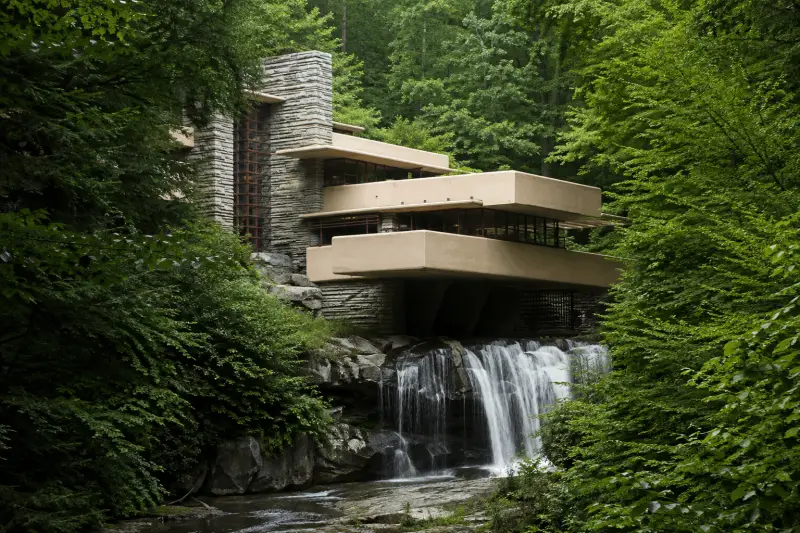
Built in 1939 over a waterfall on Bear Run in the Laurel Highlands, Fallingwater is probably the most famous private residence ever built. The house is a series of cantilevered concrete trays projecting out over the stream, anchored to a central stone core that rises directly from the rock. From outside, it looks as though it is growing out of the landscape rather than placed on it.
Inside, the stone floors, low ceilings, and floor-to-ceiling glass make the surrounding forest feel like part of the room. It is now a museum operated by the Western Pennsylvania Conservancy and open to visitors year-round.
Frank Lloyd Wright Home and Studio
Oak Park, Illinois
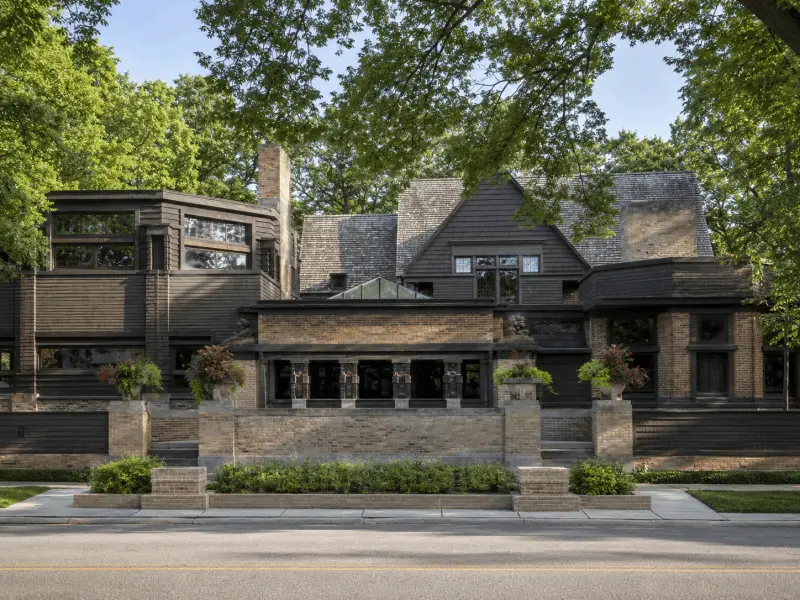
The Frank Lloyd Wright Home and Studio in Oak Park is where Wright lived and worked from 1889 to 1909, and where he developed many of the ideas that would define his career. The home is an early example of his Prairie style, with a strong horizontal emphasis, overhanging eaves, and an interior organized around a central hearth.
The attached studio, added in 1898, includes an octagonal drafting room with a suspended balcony. The building is a National Historic Landmark and now operates as a museum and tour destination managed by the Frank Lloyd Wright Trust.
Robie House
Chicago, Illinois
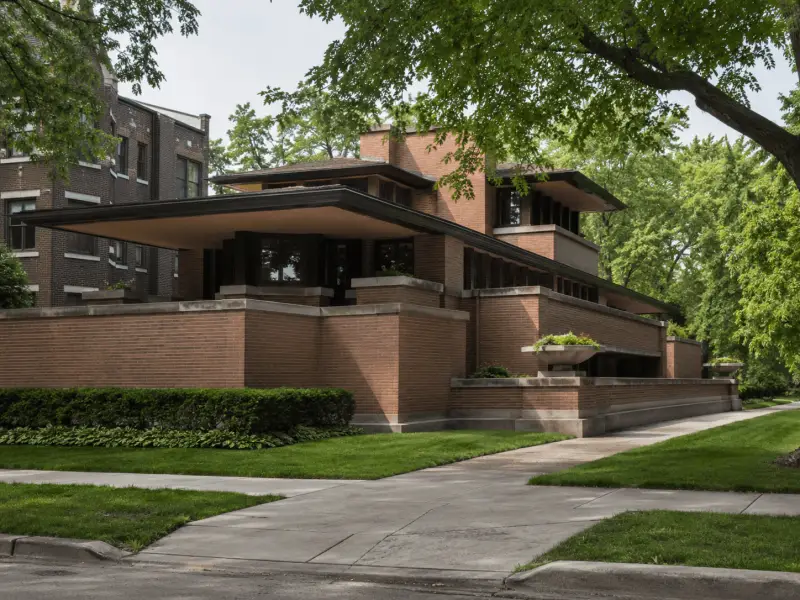
Completed in 1910 in the Hyde Park neighborhood of Chicago, the Robie House is considered the fullest expression of Wright's Prairie style. The exterior is defined by two enormous cantilevered roof planes extending far beyond the walls, thin Roman brick laid in long horizontal courses, and a low profile that keeps the building close to the ground.
The interior is a continuous open plan with no traditional room divisions, lit by art glass windows that filter light across the space. It is a UNESCO World Heritage Site and open for guided tours.
Taliesin
Spring Green, Wisconsin
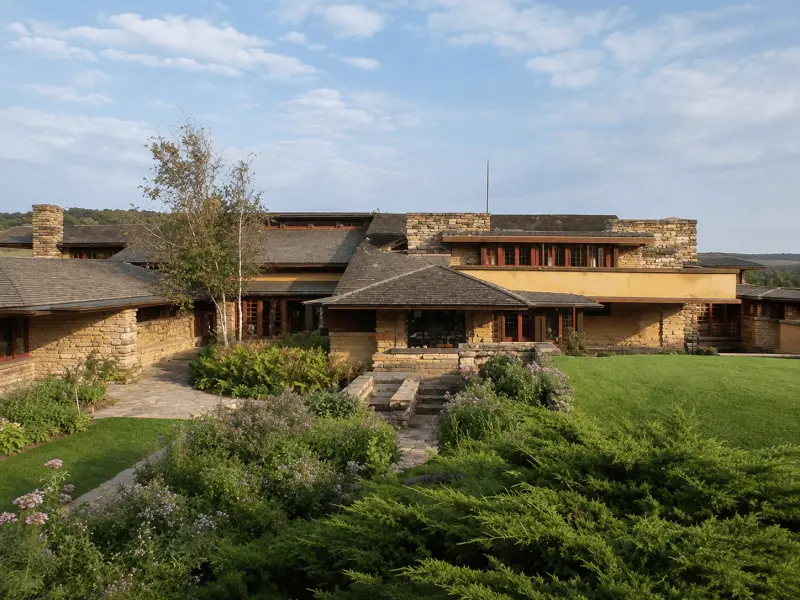
Taliesin was Wright's personal home and studio complex in the Wisconsin hills, built and rebuilt over several decades from 1911 onward. The name means shining brow in Welsh, and the building does exactly that, wrapping around the brow of a hill rather than sitting on top of it.
Local limestone and sand-colored stucco give the complex its warm, earth-toned exterior. Taliesin also served as Wright's school of architecture for many years. It is now managed by the Frank Lloyd Wright Foundation and open for tours.
Taliesin West
Scottsdale, Arizona
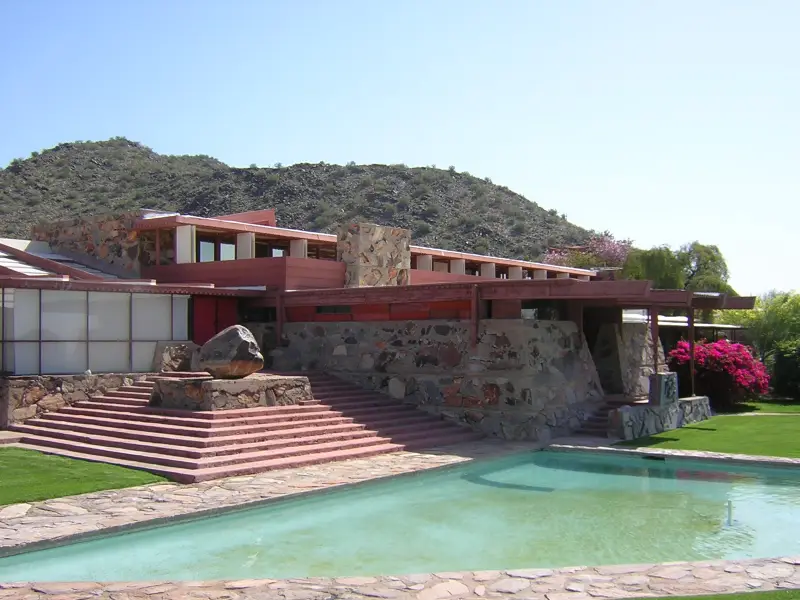
Wright began building Taliesin West in the Sonoran Desert in 1937 as his winter home and studio. The complex sits low against the desert floor, built from rough local stone and redwood with angled canvas panels in the roof that filter the intense Arizona light.
The geometry throughout is angular and desert-driven, quite different from the softer horizontality of his Midwestern work. Taliesin West is now the headquarters of the Frank Lloyd Wright Foundation and a UNESCO World Heritage Site. It offers tours and architecture school programs.
Hollyhock House
Los Angeles, California
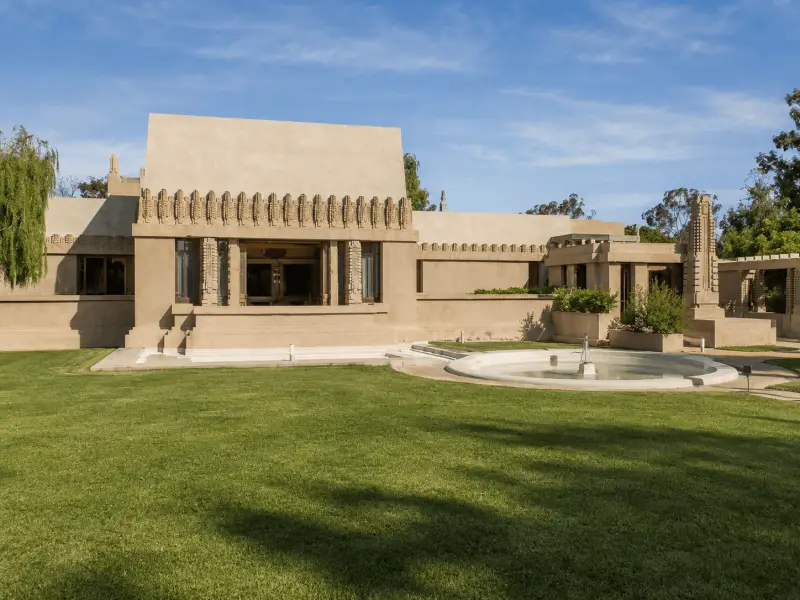
Built between 1919 and 1921 for oil heiress Aline Barnsdall, Hollyhock House sits on a hill in East Hollywood and represents Wright's California transition period. The design draws from Mayan temple architecture, with bold geometric massing, abstract hollyhock motifs cast into the concrete, and a roofline that steps and terraces outward toward the landscape.
The interior spaces open onto courtyards and terraces, blurring the distinction between inside and outside in a way that suits the Southern California climate. It is a UNESCO World Heritage Site and open to the public through the City of Los Angeles.
Darwin D. Martin House
Buffalo, New York
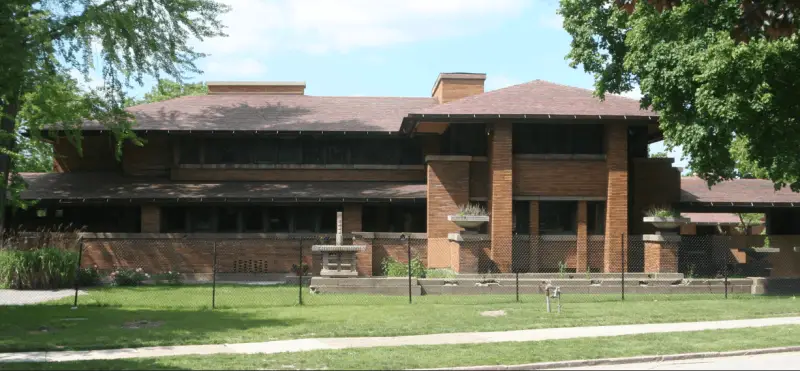
Completed in 1905, the Martin House complex in Buffalo is one of Wright's most ambitious Prairie-era residential commissions. The main house, pergola, carriage house, and gardener's cottage form a connected campus spread across a large urban lot.
Roman brick, art glass windows, and long horizontal rooflines define the exterior, while the interior is organized around a series of interconnected spaces that feel continuous rather than divided. After decades of vacancy and deterioration, the complex was restored and reopened as a museum.
Frank Lloyd Wright's Legacy in American Architecture
The majority of Frank Lloyd Wright's most significant homes are now preserved as museums, open to the public and managed by foundations, trusts, or local authorities. Some of his smaller residential designs remain in private hands, still functioning as homes more than a century after they were built.
Frank Lloyd Wright houses for sale are extraordinarily rare. When one does come to market, it is treated less like a standard real estate transaction and more like the sale of a significant cultural artifact. Buyers typically include collectors, preservation-minded individuals, and institutions.
Prices reflect both the scarcity and the architectural significance of the property. For most people, the closest they will get to owning a piece of Wright's work is visiting one of the many Frank Lloyd Wright buildings open to the public across the country, and that experience alone is worth the trip.
FAQs
How many Frank Lloyd Wright houses are there in the U.S.?
Wright designed over 1,000 structures during his career, of which around 500 were built. Approximately 380 of those still survive. The majority are residential, and most are located in the United States. Illinois alone has over 80 surviving Wright-designed structures.
Where can you see Frank Lloyd Wright homes today?
Many of his most significant homes are open to the public as museums or heritage sites. Fallingwater in Pennsylvania, Taliesin in Wisconsin, Taliesin West in Arizona, the Robie House and Frank Lloyd Wright Home and Studio in Illinois, and Hollyhock House in California all offer tours. The Frank Lloyd Wright Foundation website at franklloydwright.org maintains a full list of sites.
Are any Frank Lloyd Wright homes privately owned?
Yes. A number of Wright's smaller residential commissions remain in private ownership and are still used as homes. These are not generally open to the public, though some participate in periodic architectural tours organized through local preservation organizations.
Are Frank Lloyd Wright houses ever for sale?
Occasionally, though it is uncommon. When Frank Lloyd Wright houses for sale do appear on the market, they tend to attract significant attention and are priced accordingly.
They are listed through specialist architectural real estate brokers and high-end platforms rather than standard listing portals. Buyers should expect strict preservation requirements attached to any sale of a designated historic property.
If a Wright-designed property ever comes up for sale, a thorough property records check is essential, given its historic designation and potential restrictions. PropertyChecker.com provides access to publicly available ownership, deed, and zoning records across all 50 states.

Elena Novak leads real estate research and analysis at PropertyChecker.com, where she digs into housing trends, tracks property data, and unpacks investment strategies across the U.S. With a background in flipping homes and a degree in Business and Real Estate Development, she brings a practical, hands-on approach to market analysis. Elena is especially skilled at uncovering hidden property value and guiding both homeowners and investors through shifting market conditions. She's also passionate about sustainable design and smart home innovation. When she's not analyzing the market, she's probably knee-deep in a DIY project, scouting vintage décor, or building something new in her workshop.
Search Property & Deed Records
Table of Contents
- Inside Fallingwater, Taliesin, and Wright's Other Great Survivors
- Where Frank Lloyd Wright Homes Are Located
- Frank Lloyd Wright Homes You Can See Across the U.S.
- Fallingwater
- Frank Lloyd Wright Home and Studio
- Robie House
- Taliesin
- Taliesin West
- Hollyhock House
- Darwin D. Martin House
- Frank Lloyd Wright's Legacy in American Architecture
- FAQs
- How many Frank Lloyd Wright houses are there in the U.S.?
- Where can you see Frank Lloyd Wright homes today?
- Are any Frank Lloyd Wright homes privately owned?
- Are Frank Lloyd Wright houses ever for sale?